Fact Snapshot
- Paper: LaB6 nanocubes by salt-assisted microwave-induced solid-state combustion
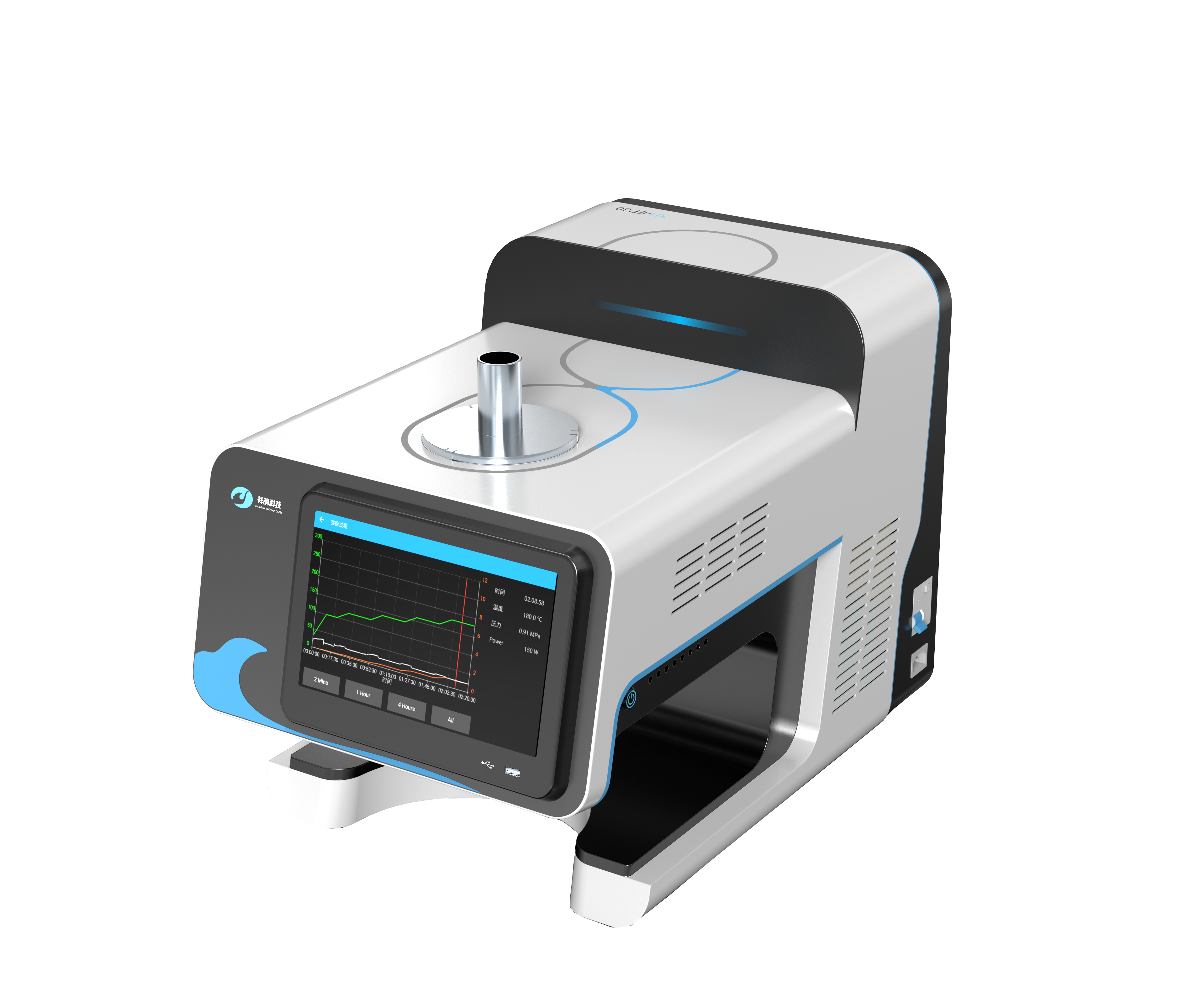
- Equipment: XH-EP30 microwave reactor used for temperature-evolution monitoring
- Publication status: SSRN Electronic Journal preprint, not peer reviewed
- Core conditions: microwave heating for 5 min; NaCl/La(NO3)3·6H2O X1 = 1; LaCl3·7H2O/La(NO3)3·6H2O X2 = 0.5
- Key result: uniform LaB6 nanocubes with D50 70.6 nm; coating reduced test-chamber temperature by 10.2 °C
- Use case: microwave synthesis of rare-earth boride powders for transparent thermal-insulation coatings
Research Abstract
The preprint proposes a salt-assisted microwave-induced solid-state combustion route for controlled LaB6 nanoparticle synthesis from La(NO3)3·6H2O, urea, and boron powder. XRD and thermodynamic analysis support the proposed formation mechanism. With NaCl and LaCl3·7H2O added at X1 = 1 and X2 = 0.5, the product consisted of uniform LaB6 nanocubes with a D50 of 70.6 nm. When used in transparent thermal-insulation glass coatings, the sample showed 71.1% visible-light transmittance and reduced the internal temperature of a test chamber by 10.2 °C compared with uncoated glass.
Research Background and Problem
Equipment Use and Experimental Conditions
| Item | Parameter |
|---|---|
| Microwave heating time | 5 min |
| NaCl ratio | X1 = 1 |
| LaCl3·7H2O ratio | X2 = 0.5 |
| Main precursors | La(NO3)3·6H2O, urea, amorphous boron |
| XH-EP30 role | temperature-evolution monitoring |
| Time | 5 min / 5 |
Key Result
| Metric | Result |
|---|---|
| Optimized particle size | D50 = 70.6 nm |
| Visible-light transmittance | 71.1% |
| Near-infrared transmittance at 1050 nm | 27% |
| Test-chamber temperature reduction | 10.2 °C |
| NaCl-only particle size at X1 = 1 | 254.8 nm |
| Particle size | 190 nm |
Evidence Details
in the presence of NaCl and LaCl3·7H2O (X1=1, X2=0.5), the obtained particles consist of uniform regular cubes with D50 value of 70.6 nm
glass coated with LaB6 nanocubes exhibits a visible light transmittance of 71.1% and reduces the internal temperature of a test chamber by 10.2°C compared to uncoated glass
Optical-transmittance evidence: source values include 71.1 %, 1050 nm, 27 %, 10.2 °C. Entities: LaB6.
Particle-size evidence: source values include X1 = 1, 254.8 nm, X1 = 2, 446.9 nm. Entities: NaCl.
Temperature-evolution evidence: source values include 23 s, 1123.1 °C, 1041 °C. Entities: XH-EP30, NaCl, LaCl3.
Particle-size evidence: source values include X2 = 0.25, 190 nm, 78.5 nm. Entities: LaCl3, LaOCl.
Time: 5 min / 5
Mechanism / Method Highlights
- LaOCl nanocrystals act as nucleation and growth-regulation sites.
- Molten NaCl provides a more uniform high-temperature medium and suppresses sintering.
- XH-EP30 monitoring captured rapid temperature evolution during microwave-induced combustion.
- Particle size, La:B ratio, and optical performance improved together under the optimized salt combination.
Application Value
- Demonstrates a minute-scale microwave route for LaB6 nanocube preparation.
- Clarifies that XH-EP30 is directly evidenced as the microwave temperature-evolution monitoring platform.
- Shows application-level validation through visible transparency and temperature-reduction tests.
Related Equipment
FAQ
Is this a peer-reviewed journal article?
What is the directly evidenced role of XH-EP30?
What was the best application result?
LaB6 nanocubes: salt-assisted microwave-induced solid-state combustion synthesis mechanism and thermal insulation application
SSRN, 2026
DOI: 10.2139/ssrn.6024609