Fact Snapshot
- Paper: Preparation of zein-rutin supramolecular nanoparticles using pH-ultrasound-shifting
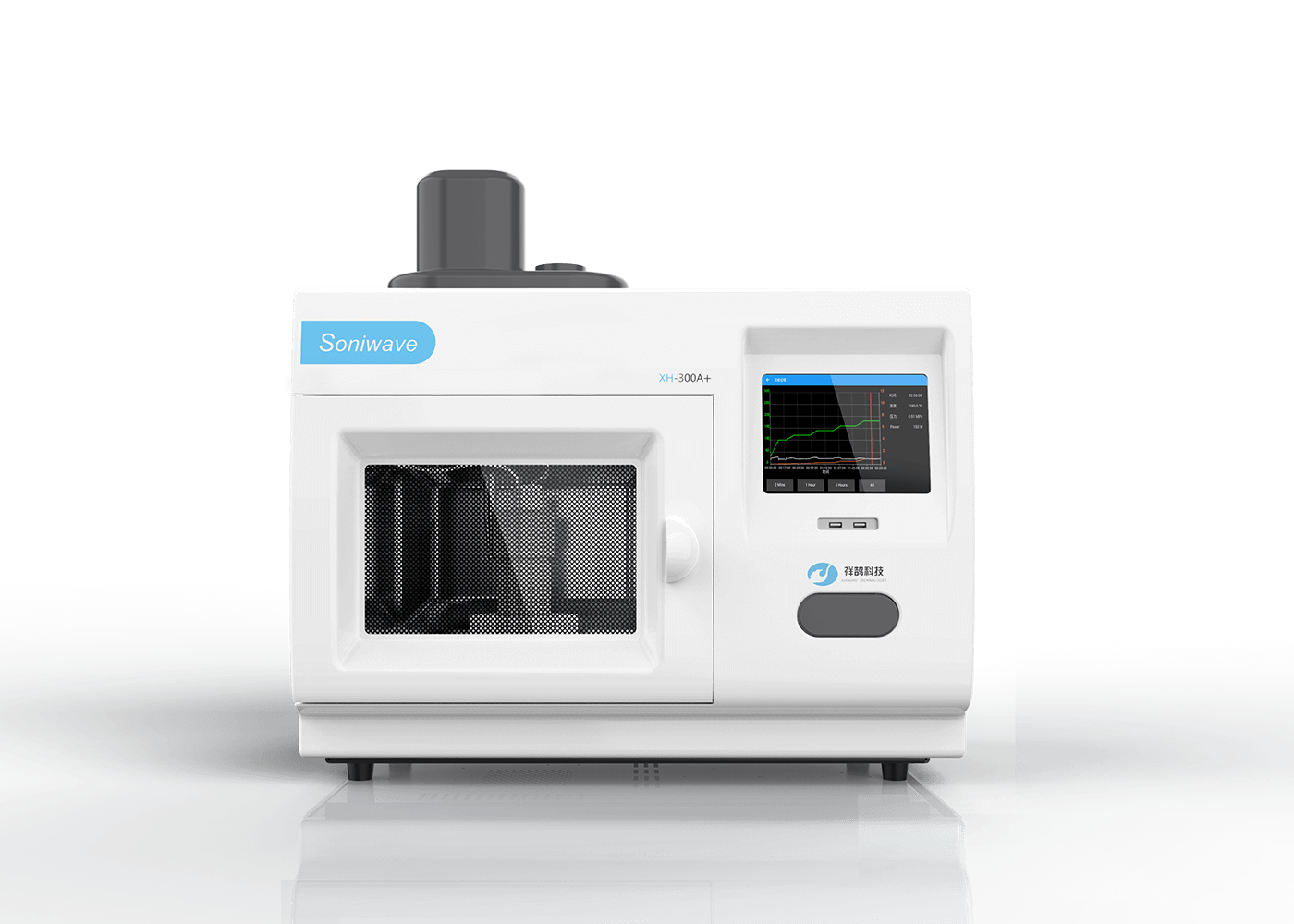
- Equipment: XH-300A+ ultrasonic microwave synthesis/extraction instrument
- Journal and year: Food Chemistry, 2025
- Core conditions: 25 kHz ultrasound; optimized power up to 500 W; treatment time 1-5 min; pH-shifting route
- Key result: EE 87.89 ± 1.28%; LC 23.97 ± 0.56%; solubility improved 9.2-fold
- Use case: protein-polyphenol delivery systems for functional food and oral delivery
Research Abstract
This study prepared zein-rutin supramolecular nanoparticles using a pH-ultrasound-shifting method. The optimized Z-R-P-U system achieved 87.89 ± 1.28% encapsulation efficiency and 23.97 ± 0.56% loading capacity. Multispectral analysis and molecular docking indicated that hydrogen bonding, van der Waals forces, and hydrophobic interactions dominated zein-rutin binding. The nanoparticles were about 150 nm, remained below 200 nm after 28 days of storage, improved rutin solubility by 9.2-fold, and enhanced antioxidant activity, bioaccessibility, and controlled release behavior.
Research Background and Problem
Equipment Use and Experimental Conditions
| Item | Parameter |
|---|---|
| Ultrasound frequency | 25 kHz |
| Ultrasound power range | 0-500 W |
| Ultrasound time | 1-5 min |
| pH-shifting window | pH 7-12 |
| Zein concentration | 1-5 mg/mL |
| Ultrasonic power | 500 W |
| Time | 5 min |
Key Result
| Metric | Result |
|---|---|
| Encapsulation efficiency | 87.89 ± 1.28% |
| Loading capacity | 23.97 ± 0.56% |
| Particle size | about 150 nm |
| Apparent solubility vs free rutin | 9.2-fold higher |
| DPPH scavenging increase | 10.26% |
| ABTS+ scavenging increase | 12.23% |
| FRAP increase | 31.43% |
Evidence Details
Release-kinetics evidence: source values include 3 h, 97.94%, 99.25%, R2 = 0.98, n = 0.17, n = 0.27. Entities: Z-R-P, Z-R-P-U, first-order, SGF, SIF.
Activation-energy evidence: source values include -8.3 kcal/mol, ΔG < 0, ΔH = -40.57, ΔS = -39.81.
Equipment-detail evidence: source values include 25 kHz, 0-500 W, 1-5 min, 1-5 mg/mL.
Salt-stability evidence: source values include 220 nm, 150 nm, 0 mmol/L, 150 mmol/L, 228.33 nm, 403.27 nm, 156.17 nm, 221.93 nm, 76.61%, 42.11%, 81.4%, 17.7%. Entities: Z-R-P, Z-R-P-U.
Storage-stability evidence: source values include 4 °C, 228.33 nm, 310.57 nm, 156.17 nm, 196.24 nm, 200 nm, 100%, 81.5%, 90.8%. Entities: Z-R-P, Z-R-P-U.
As shown in Fig. 6E, during the SGF phase, the bioaccessibility of Z-R-P and Z-R-P-U increased by 7.32 % and 15.15 %, respectively, compared to rutin, while in the SIF phase, the increases were 37.01 % and 48.85 %.
As shown in Fig. 6 A, the apparent solubility of rutin, Z-R-P, and Z-R-P-U in water (after 4 h) was 137.47 ± 1.79 μg/mL, 954.41 ± 7.56 μg/mL, and 1264.51 ± 49.92 μg/mL, respectively.
Additional source evidence: source values include 4 h, 137.47 ± 1.79 μg/mL, 954.41 ± 7.56 μg/mL, 1264.51 ± 49.92 μg/mL, 9.2 fold. Entities: Z-R-P, Z-R-P-U.
Release-kinetics evidence: source values include R2 = 0.98, RSS = 12.11, RSS = 16.93.
Specifically, the DPPH free radical scavenging activity of Z-R-P-U increased by 10.26 %, the ABTS+ free radical scavenging activity by 12.23 %, and the FRAP value by 31.43 % compared to rutin.
The ultrasonic treatment was performed at a frequency of 25 kHz using an XH-300A+ ultrasonic microwave synthesis/extraction instrument (Beijing XiangHu Science and Technology Development Co., Ltd., Beijing, China).
This study developed zein-rutin supramolecular nanoparticles (Z-R-P-U) using a pH-ultrasound-shifting method, achieving high encapsulation efficiency (87.89 ± 1.28 %) and loading capacity (23.97 ± 0.56 %).
Ultrasonic power: 500 W
Time: 5 min
Mechanism / Method Highlights
- pH-shifting exposes internal binding sites in zein.
- Ultrasound cavitation and mechanical effects improve dispersion and assembly.
- Docking gave a binding energy of -8.3 kcal/mol.
- FTIR, CD, and XRD support stronger hydrogen bonding, structural rearrangement, and conversion of rutin toward an amorphous state.
Application Value
- Provides a traceable XH-300A+ case in pH-ultrasound-assisted nanoparticle preparation.
- Shows a complete evidence chain from preparation and structure to digestion and release kinetics.
- Keeps the equipment claim bounded: the final material properties are outcomes of the Z-R-P-U formulation and process.
Related Equipment
FAQ
Which Xianghu instrument is used?
What is the main result?
What problem does the study address?
Preparation of zein-rutin supramolecular nanoparticles using pH-ultrasound-shifting: binding mechanism, functional properties, and in vitro release kinetics
Food Chemistry, 2025
DOI: 10.1016/j.foodchem.2025.144087